Tuesday 09 / December / 2025
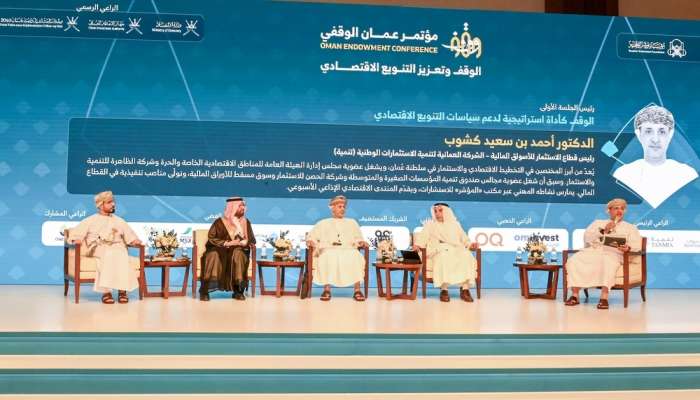
Muscat: The activities of 2nd Oman Endowment Conference titled “Endowments and Enhancing Economic Diversification,” commenced on Tuesday.
The conference, organised by Boushar Endowment Foundation in cooperation with the Ministry of Endowments and Religious Affairs, aims to discuss the strategic role of endowments as an economic tributary in supporting diversification and sustainable development plans, and to review innovative investment models to enhance financial sustainability.
The opening of the conference was held under the patronage of by HH Sayyid Taimour bin Asa’ad Al Said, Chairman of the Board of Directors of the Central Bank of Oman.
The two-day conference is held with broad participation from stakeholders, specialists, and experts in the field of endowments from the GCC countries and the Arab and Islamic world.
Malik Hilal Al Yahmadi, Chairman of the Board of Directors of Boushar Endowment Foundation, stated in the organizing committee’s speech: “Endowments represent a fundamental pillar in building societies.
Throughout our rich Omani and Islamic history, endowments have been among the most important cornerstones contributing to serving all vital sectors.
Today, in light of the accelerating pace of economic transformations globally, endowments have become one of the main pillars that governments in the region prioritize and are keen to include in their strategic plans and national visions.”
Dr. Mohammed Said Al Ma’amari, Minister of Endowments and Religious Affairs, affirmed during the conference’s main session that the Ministry of Endowments and Religious Affairs in Oman operates through four strategic orientations across all its sectors, including the endowment sector. These include: Contributing to achieving sustainable development by enhancing balanced religious education, managing endowments effectively, building local and international partnerships, and managing Zakat efficiently.
The second theme involves building trust and effective community partnership through continuous interaction and communication, governance of religious sectors, investing in technology and digital platforms, engaging the community, empowering individuals, and encouraging digital and community initiatives.
The third theme focuses on investing religious resources and includes governance of resource management, effective oversight, long-term planning, protecting religious gains, and stimulating innovation.
The fourth theme is connected to promoting the values of moderation and citizenship by enhancing the role of religious institutions and qualifying religious cadres.
For his part, Abdulsalam Mohammed Al Murshidi, Chairman of Oman Investment Authority, stated: “Endowments, in general, possess a massive global wealth; however, most of them remain captive to real estate investment and suffer from weak governance, which limits their modern economic role.”
He clarified that endowment institutions in Oman, including Boushar Endowment Foundation, have begun moving towards innovation, expanding community awareness of endowments, and transitioning from traditional charity work to an economic role that contributes to entrepreneurship and diversifying income sources.
Over the two days, the conference includes 4 sessions focusing on the theme of endowments as a strategic tool to support economic diversification policies.
This theme reviews the role of endowments as an economic component capable of supporting economic diversification plans in the GCC countries.
It also discusses national policies that have adopted endowments as a strategic tool in economic transformation and sustainable development programs, and directing endowments towards priority sectors such as education, health, innovation, and food security, along with the endowment’s ability to enhance integration between developmental goals and national economic policies.
The second theme, “Innovation in Endowment Investments,” focuses on developing innovative investment models that contribute to diversifying endowment income sources and enhancing financial sustainability. It reviews new opportunities such as joint endowment funds, diversified portfolios, and green sukuk. It also highlights regional and global experiences that have utilized endowments in promising sectors like renewable energy, technology, tourism, and health.
The third theme is titled “Innovative Endowment Financial Models in the Economy” and focuses on exploring modern financial tools that rely on the effectiveness of endowments in the economy, such as digital technologies and blockchain. It reviews the experience of Turkiye’s “Waqf Bank” as a leading model that integrates endowments into the national financial system and transforms them into an economic resource. It also discusses endowment financial models, endowment sukuk, and advanced investment portfolios, highlighting the role of these tools in supporting economic diversification, enhancing financial sustainability, and developing resources to serve national priorities.
The fourth theme addresses the role of endowments in enabling entrepreneurship and small and medium enterprises by funding emerging and innovative projects through dedicated endowment resources and building effective partnerships with business incubators and accelerators within a developmental endowment vision.