Wednesday 07 / October / 2026
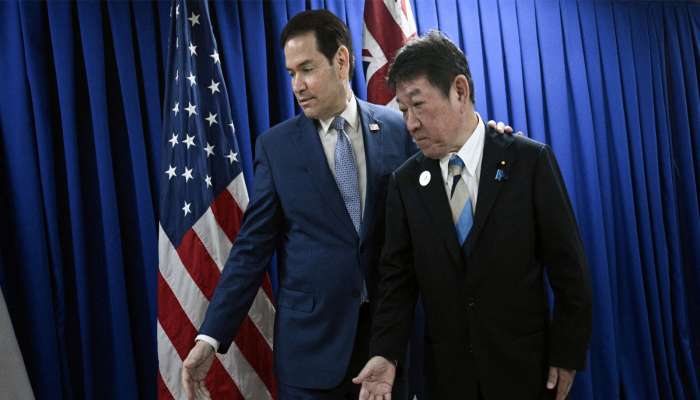
Manila: On the sidelines of the ASEAN Foreign Ministers' meetings in Manila, Japanese Minister for Foreign Affairs Motegi Toshimitsu met with US Secretary of State Marco Rubio on Tuesday to align strategies on pressing Middle Eastern tensions and Indo-Pacific security.
During their exchange, Minister Motegi underscored the urgency of de-escalating tensions surrounding Iran. He specifically emphasised the critical need to safeguard free and safe navigation through the Strait of Hormuz, a crucial maritime corridor for global energy supplies, without incurring additional transit or security costs.
"Minister MOTEGI and Secretary Rubio exchanged views on the situation surrounding Iran. Minister MOTEGI emphasaized the importance of de-escalating the situation as soon as possible and ensuring free and safe navigation through the Strait of Hormuz without additional costs," read the Ministry of Foreign Affairs of Japan press release.
The two foreign policy chiefs also engaged in broad discussions regarding security and strategic cooperation across the Indo-Pacific region.
Concluding their meeting, Minister Motegi and Secretary Rubio reaffirmed that Tokyo and Washington will maintain tight communication and coordinate closely in response to unfolding international developments in both the Middle East and the Indo-Pacific.
"They also exchanged views on issues related to the Indo-Pacific. They confirmed that they would maintain close communication in responding to developments in the international situations surrounding Iran and the Indo-Pacific," added the release.
Meanwhile, US Secretary of State Marco Rubio accused Iran of failing to honour commitments in negotiations reached with Washington last month and said Tehran was "not serious about talks," while warning that allowing it to control the Strait of Hormuz would set a "very dangerous precedent" for international trade and freedom of navigation.
Speaking at the ASEAN Post-Ministerial Conference with the United States in Manila, Rubio said Washington remained committed to diplomacy and was willing to pursue a negotiated resolution with Iran.
Reiterating the US position, Rubio said Washington remained open to diplomacy but warned that there would be consequences if agreements were not honoured.
"The United States remains open and willing to engage in positive, constructive negotiations and talks so long as the commitments that are made are kept. And when those commitments are not kept, which is what's happened in this particular case, then there will be consequences," he said.
The remarks come as tensions between Iran and the United States escalated after the collapse of the 14-point MoU, signed last month, aimed at ending the hostilities between the two sides and opening the pathway for further negotiations, particularly on Iran's nuclear programme and the Strait of Hormuz.
Its collapse renewed the conflict in West Asia, with the US striking Iranian military and civilian assets, and the Islamic Republic also targeting American bases across the Gulf in retaliatory strikes.
On the same day, the Quad Foreign Ministers' Meeting (FMM) reaffirmed the grouping's commitment to strengthening a free and open Indo-Pacific and reiterated its "unwavering support" for ASEAN unity and centrality, as the four countries discussed regional challenges and cooperation priorities.
The meeting was held in the Philippines' Manila on the sidelines of ASEAN-related ministerial engagements, with External Affairs Minister S Jaishankar, Australian Foreign Minister Penny Wong, Japanese Foreign Minister Toshimitsu Motegi and US Secretary of State Marco Rubio participating.