Tuesday 04 / August / 2026
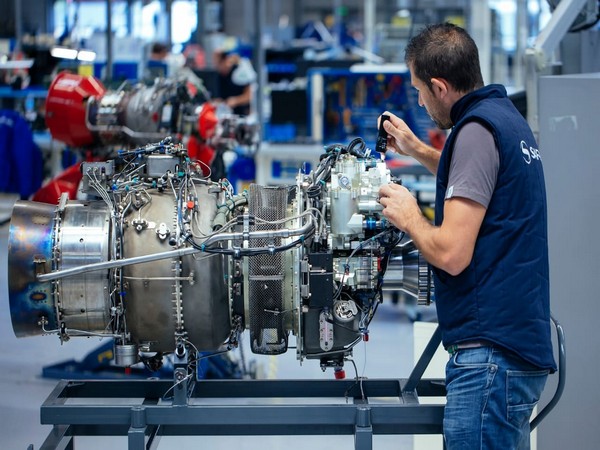
NEW DELHI: India is reportedly on the verge of approving a landmark joint venture between France's Safran and the Gas Turbine Research Establishment (GTRE) to develop an indigenous next-generation fighter aircraft engine, a project expected to power the country's future stealth combat aircraft and carrier-based fighters.
According to a report by the Hindustan Times, the proposal has reached the Cabinet Committee on Security (CCS)—India's highest decision-making body for major defence acquisitions—and is expected to receive approval before August 15. The report is based on comments by the newspaper's Executive Editor, Shishir Gupta, and has not yet been officially confirmed by the government.
The proposed engine will initially produce 120 kilonewtons (kN) of thrust, with an upgraded 140 kN variant planned later. Nine prototype engines are expected to be built and certified. The engine is intended to power India's Advanced Medium Combat Aircraft (AMCA) and the Twin Engine Deck-Based Fighter (TEDBF) for the Indian Navy.
A key feature of the reported agreement is that India would retain 100 per cent intellectual property rights over the engine. This would mark a significant departure from previous technology-transfer arrangements with foreign suppliers, under which critical technologies—including hot-section design, single-crystal turbine blade manufacturing and source codes—were not fully shared.
Unlike conventional defence procurements, the engine programme is being pursued as a Defence Research and Development Organisation (DRDO) development project rather than through the standard Defence Acquisition Procedure. As a result, it does not require stages such as Acceptance of Necessity or a Request for Proposal. Instead, the proposal has reportedly moved through the Ministry of Defence, the National Security Council Secretariat and the Ministry of Finance before reaching the CCS.
The project follows a similar approval pathway to the AMCA programme itself, which received CCS clearance in March 2024 with an estimated budget of ₹15,000 crore.
Defence Minister Rajnath Singh first publicly confirmed in August 2025 that India would begin fighter-engine manufacturing in partnership with Safran. Three months later, Safran Chief Executive Olivier Andriès stated that the company would jointly develop a new fighter engine with DRDO while transferring critical technologies, including the hot section, for an engine in the 120–140 kN thrust class.
The total value of the programme remains uncertain. Estimates circulating in media reports range from ₹20,000 crore to ₹61,000 crore, although no official cost has been announced. Some analysts argue that the higher figure may refer to a broader national aero-engine development mission rather than the Safran agreement itself.
The competition for the programme also appeared contested until recently. Earlier reports suggested Rolls-Royce had offered full technology transfer and proposed an engine development timeline extending to production by 2036, while later reports indicated both Rolls-Royce and Safran had submitted final commercial proposals.
India's principal condition throughout the negotiations has reportedly been complete ownership of the engine's intellectual property, including design authority, configuration control, source codes and lifecycle management, with no rights retained by the foreign partner to reuse the jointly developed design.
GTRE enters the programme with decades of engine-development experience through the Kaveri project. Since the 1980s, it has produced nine full-scale Kaveri prototypes and completed more than 3,200 engine tests. Although the Kaveri engine was eventually delinked from the Tejas fighter programme after falling short of required thrust, it has undergone flight testing aboard an Il-76 flying testbed in Russia.
India has also begun strengthening its domestic aero-engine supply chain. In 2025, PTC Industries received its first GTRE order to manufacture ready-to-fit single-crystal turbine blades, while GTRE is constructing a 130 kN twin-cell engine test facility near Bengaluru to support future fighter-engine development.
However, important infrastructure gaps remain. India still lacks a domestic high-altitude engine test facility and continues to rely on Russia for such testing. Plans are also underway to convert Su-30MKI aircraft into indigenous flying testbeds for future engine trials.
If approved, the Safran-GTRE partnership would represent one of India's most ambitious defence technology programmes, significantly advancing the country's long-standing goal of achieving self-reliance in advanced military aero-engine development.