Wednesday 23 / September / 2026
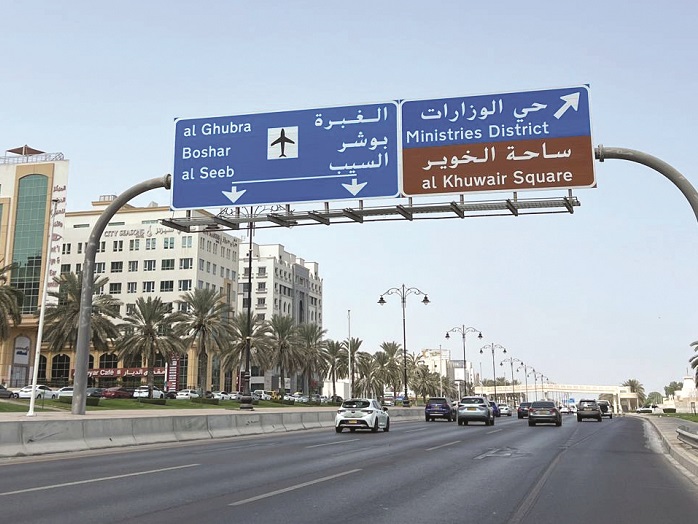
MUSCAT: Muscat Governorate has begun field implementation of Oman’s National Addressing Project, with street and building signboards now being installed as part of efforts to establish a unified national addressing system.
More than 80% of street naming and verification of addressing-unit data has been completed in the pilot areas, marking a major step towards creating a standardised address system across the governorate.
Field surveying has started in the pilot area of Quriyat to verify locations for street signs and ensure that installations comply with approved technical standards. The field implementation follows the completion of street naming and verification of addressing-unit data in the targeted pilot areas across the wilayats of Muscat Governorate.
The project aims to provide every home, establishment and facility with a unified national address linked to accurate geographical coordinates. The system will make it easier to locate destinations and gradually reduce reliance on traditional descriptions based on landmarks or informal directions.
Following completion of the pilot areas, the project will move to major urban centres and other areas, with the eventual aim of covering all wilayats of Muscat Governorate. The National Addressing Project is being implemented through a partnership between the Ministry of Housing and Urban Planning, Muscat Governorate and Muscat Municipality.
The ministry oversees the National Addressing System as the regulatory authority responsible for establishing and managing the central database and setting standards and regulations for street naming and building numbering under Ministerial Decision No. 200/2024. >A4
Muscat Governorate, in coordination with Muscat Municipality, is responsible for implementing addressing activities, including approving street names, managing and updating the governorate’s database, verifying addressing units and installing signboards.
National addressing teams are monitoring implementation across the governorate’s wilayats and working with relevant authorities to verify data and ensure compliance with technical and organisational requirements. They are also involved in reviewing and approving street names while taking into account the historical, cultural and urban characteristics of each wilayat.
The offices of the Walis are also supporting implementation by coordinating with addressing teams and relevant authorities, facilitating fieldwork and helping identify challenges and requirements.
Easier access
The unified addressing system is expected to make it easier and faster to locate homes, businesses and public facilities.
Once operational, users will be able to search for addresses through the National Addressing System’s application and access locations using digital maps and navigation services.
The system will also be linked to government platforms and other digital services, providing a common and reliable reference for locations.
A unified address is expected to benefit emergency and public services, including ambulance services, Civil Defence and the Royal Oman Police, as well as municipal, postal and delivery services.
Utilities such as electricity, water and telecommunications, along with health, education and social services, will also benefit from more accurate location information.
The system will also support civil and national registration, commercial and investment services, land management and urban planning.
Supporting digital transformation
The National Addressing System will provide a unified national spatial database that can be linked to government systems, helping authorities exchange information, reduce duplication and improve the quality and efficiency of digital services.
The database will provide up-to-date information on streets, buildings and addressing units, supporting urban planning, infrastructure development, public-service distribution, government asset management and maintenance planning.
The system is particularly significant for Muscat Governorate as the capital continues to experience urban growth. Accurate spatial data can help authorities monitor development, analyse population density, plan future expansion and identify areas requiring additional services and facilities.
The system will also support the development of smart-city applications, including asset management, traffic mobility, emergency response, logistics and other location-based services.
Boost for deliveries and businesses
The unified addressing system is expected to improve logistics and delivery services by making locations easier to identify, helping reduce delivery times, operational costs and errors.
E-commerce and postal services are also expected to benefit from standardised and reliable addresses.
Small and medium-sized enterprises will be able to register their locations using approved national addresses, making it easier for customers to find their businesses and improving their visibility on digital maps and e-commerce platforms.
The system is also expected to support investors by providing reliable location information for projects and establishments, while helping authorities verify commercial addresses and improve licensing and related services.
Public cooperation
Public participation will be important as the project moves into wider implementation.
Residents and owners of establishments in targeted neighbourhoods will be notified before signboard installation begins. They will be expected to cooperate with field teams and facilitate access to installation locations when required.
The Ministry of Housing and Urban Planning, in cooperation with Muscat Governorate and other relevant authorities, is also conducting awareness campaigns to explain the objectives of the National Addressing System and how citizens, residents and businesses can use it.
The project is ultimately intended to create a single, accurate and reliable reference for addresses, supporting easier access, better public services, stronger digital integration and more effective urban planning across Muscat Governorate.
ENDS