Thursday 12 / March / 2026
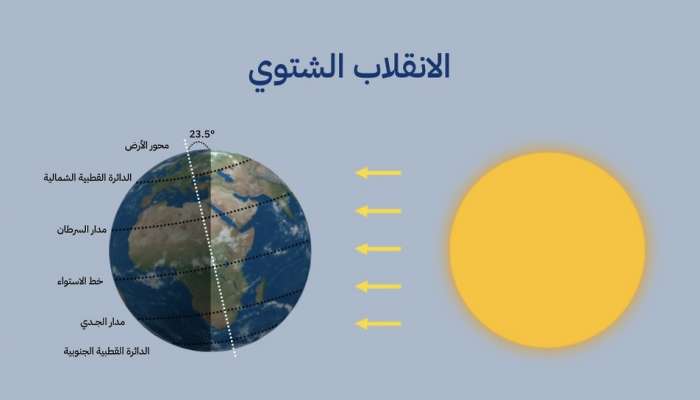
Muscat: The Sultanate of Oman will witness the winter solstice tomorrow, marking the astronomical beginning of winter in the Northern Hemisphere for the year 2025. The phenomenon will occur at 7:03 pm local time, making it the longest night and the shortest day of the year.
Speaking to the Oman News Agency (ONA), Ma’athir bint Khamis Al-Wahaibi, Chair of the Community Engagement Committee at the Oman Astronomical Society, explained that tomorrow will record the shortest daylight hours and the longest night of the year. In Muscat, the sun will rise at 6:44 am and set at 5:25 pm, resulting in a total day length of 10 hours and 41 minutes.
She noted that the winter season will last for 88 days, 23 hours, and 42 minutes.
Al-Wahaibi clarified that the winter solstice is an astronomical phenomenon resulting from the tilt of the Earth’s axis and its orbit around the sun. The Earth’s axial tilt of approximately 23.5 degrees causes the Northern and Southern Hemispheres to alternate in receiving direct sunlight throughout the year.
She stressed that the distance between the Earth and the sun is not responsible for the changing seasons, dismissing the common misconception that winter and summer occur due to proximity to the sun. In fact, the Earth reaches its closest point to the sun, known as perihelion, during the winter of the Northern Hemisphere, confirming that colder temperatures are due to the angle of sunlight rather than distance.
During the winter solstice, she explained, the sun reaches its southernmost position in the sky, while the North Pole tilts furthest away from the sun. As a result, some regions of the Earth do not experience sunrise or sunset on this day. In the Arctic Circle, the sun remains below the horizon throughout the day, while in the Antarctic Circle, it stays above the horizon, a phenomenon known as the “midnight sun.”
She added that one of the key features of the winter solstice is the sun rising from the far southeast and following a low apparent path across the sky. Shadows cast by objects are also at their longest during this period.
Al-Wahaibi noted that the winter solstice follows the autumnal equinox, which occurred in September, when the sun was directly overhead at the equator. Since then, the sun’s apparent movement has gradually shifted southward, leading to decreasing daylight hours in the Northern Hemisphere until they reach their minimum on the day of the winter solstice, while the opposite occurs in the Southern Hemisphere.
She concluded by explaining that the Earth has two primary motions: its rotation around its axis every 24 hours, resulting in day and night, and its revolution around the sun approximately every 365.25 days, giving rise to the four astronomical seasons.
“During the winter solstice, it appears as though the sun rises from the same southern point on the horizon for several days before beginning its apparent northward journey again due to Earth’s orbital motion,” she said. “After this period, daylight hours gradually increase until they equal nighttime during the spring equinox on March 20, 2026.”