Tuesday 23 / December / 2025
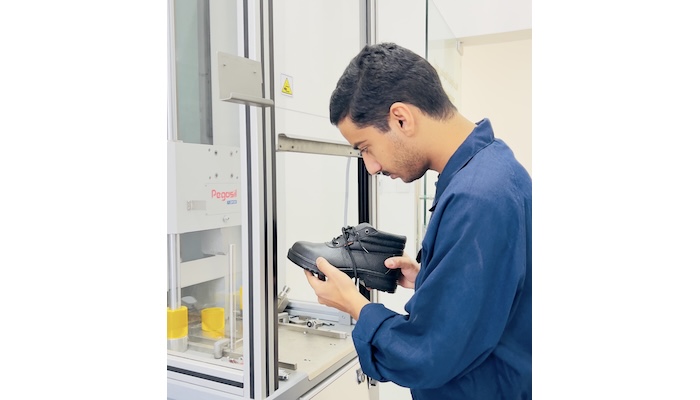
Muscat: The Directorate General of Standards and Metrology (DGSM) at the Ministry of Commerce, Industry and Investment Promotion (MoCIIP) has revealed that 10 out of 16 registered safety footwear brands failed to meet approved testing requirements, as part of the Ministry’s ongoing efforts to strengthen product oversight in the local market and ensure worker safety across various work environments.
Ibrahim bin Mohammed Al Shaeili, a physicist at the DGSM, said that worker safety remains a top priority, noting that the Ministry has introduced advanced, high-efficiency testing equipment to conduct precise technical examinations. These include an impact resistance testing device for safety footwear, which features advanced technologies to ensure accurate and reliable results.
He explained that the Physics and Building Materials Laboratory conducts tests using approved equipment to assess several key characteristics, including impact and compression resistance, puncture resistance, as well as the quality and durability of materials used in the manufacture of protective footwear.
Al Shaeili added that the inspections cover all safety footwear available in the local market, whether locally produced or imported, and used across industrial, construction and other work environments. The goal is to verify compliance with approved standard specifications, thereby protecting workers and reducing occupational risks.
He confirmed that these tests are mandatory prior to the circulation or use of safety footwear and are carried out in accordance with international standards, including ISO 20344, which specifies test methods for protective footwear, and ISO 20345, which sets out basic safety requirements. Test results for 2025 showed that six brands passed, while 10 brands failed, underscoring the importance of these procedures in identifying non-compliant products and ensuring market quality.
The Directorate General of Standards and Metrology reaffirmed its commitment to continuing inspection and testing measures to enhance consumer confidence and reinforce adherence to safety standards and product quality in line with international best practices.