Wednesday 14 / January / 2026
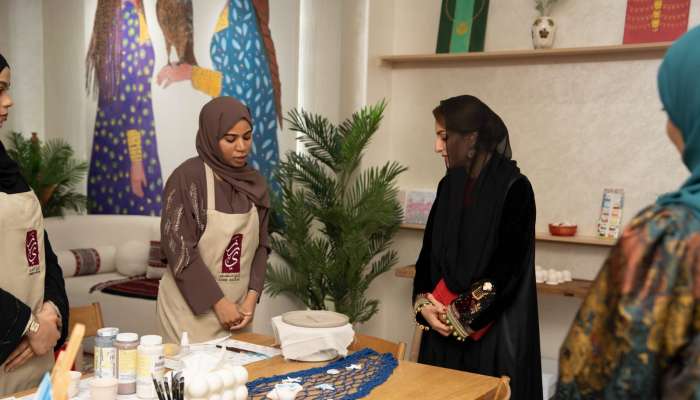
Khasab--- The "Zaree Khasab" project in Musandam Governorate embodies a unique tourism experience that merges the charm of the location with the depth of cultural memory. The project seeks to enhance the governorate's position on the global tourism map by providing interactive cultural content that showcases local heritage in a manner that resonates with diverse cultures.
Eng. Iman Saleh Al Salti, the project owner, told Oman News Agency (ONA) that the project was established in 2012 with a vision rooted in the belief that true tourism allows visitors to interact with the soul of a place and its people. Launched as a corporate social responsibility initiative by OMRAN Group, the project initially focused on empowering 50 local women through training programs in hospitality, entrepreneurship, and the English and Italian languages, thereby building their capacities to engage in tourism and cultural activities.
She added that, based on this foundation, the project works to transform the tourist from a passive recipient into an active participant in the cultural details of Musandam through sensory experiences based on touch, observation, and direct practice.
Al Salti stated that the project offers an integrated tourism experience that combines the introduction of the governorate's cultural heritage with support for the local economy. A key feature of this experience is the sale of souvenirs and handicrafts made by Musandam artisans; each piece carries a story inspired by the governorate's marine and mountainous environments, becoming a "cultural ambassador" that travels with the visitor across the globe.
She noted that the experience is not limited to acquiring products but extends to living local customs and traditions through participation in pottery making, henna application, and wearing traditional Omani attire, as well as experiencing Omani hospitality and traditional cuisine that reflects the generosity and authenticity of the Musandam community.
She mentioned that ceramic art is the "beating heart" of the "Zaree Khasab" project, particularly at the Bassa Beach branch, where visitors reconnect with humanity's primal relationship with the earth. There, a piece of clay in the visitor's hands—accompanied by the pottery wheel—is transformed into an artwork inspired by Musandam’s terrain, culminating in a personalized souvenir that encapsulates the story of the place in tangible form.
Al Salti emphasized that "Zaree Khasab" has succeeded in turning homes into miniature production workshops and has contributed to empowering the women of Musandam by training them as professional artisans and certified trainers. The project provided them with marketing support, creating a model for a sustainable creative economy that enhances Omani women's participation in economic and social development while giving traditional crafts a contemporary dimension and providing direct and indirect employment opportunities.
She explained that the project enhances the cognitive dimension by providing tour guiding services through female guides licensed by the Ministry of Heritage and Tourism. This ensures the delivery of accurate and reliable content reflecting Musandam’s history and culture in a professional.
Al Salti reported that the project’s impact has transcended local borders, carrying the name of the Sultanate of Oman to prestigious international platforms, including the Arabian Travel Market in Dubai, the Maritime Heritage Exhibition in France, and the Zayed Heritage Festival in Abu Dhabi. Thus, the project has become a bridge for cultural communication, a primary stop for visitors to the governorate, and a successful model for cultural tourism based on authenticity and innovation.
Regarding partnerships, she noted that the project receives active institutional support from several entities, foremost among them OQ, which supported the establishment of a permanent tent at Khasab Port. This tent serves as a major platform for receiving cruise ships from around the world and introduces port visitors to the cultural and heritage assets of Musandam.
She praised the leading role of the Ministry of Heritage and Tourism, which was among the project's earliest supporters and has been keen to select it to represent Oman at various international forums and exhibitions. She also commended the support from the Office of the Governor of Musandam, reflecting the integration of institutional efforts to promote cultural tourism in the governorate.
Al Salti emphasized that the visit of Her Highness the Honourable Lady Assayida Ahd Abdullah Hamed Al Busaidi, Spouse of the Sultan of Oman, to the project embodies her interest in supporting national projects rooted in the identity and heritage of the place. She added that the visit reflects great appreciation for the efforts of Omani women in creativity, production, and the preservation of heritage.
Finally, she stated that this visit represents direct support for women's empowerment by encouraging them to invest in their skills and transform them into authentic, high-quality products. She noted that the presence of the Honourable Lady gives the women working in this field a sense of pride and confidence, confirming that their work is not merely a craft, but a cultural message held in high esteem by the leadership and society.