Sunday 05 / July / 2026
Nizwa: Al Dakhiliyah Governorate has enhanced its position as one of the leading governorates in attracting food security-related investments, following the awarding of investment projects worth approximately OMR158 million until the end of May 2026.
This coincided with the offering of 45 investment opportunities, achieving a completion rate of 113 percent of the annual target, which reflects the growing attractiveness of the investment environment in the governorate and the accelerating pace of executing productive projects in the agricultural, livestock, fisheries, and food sectors.
Eng. Omar Ahmed Al Busaidi, Head of the Marketing Department at the Directorate General of Agriculture and Water Resources in Al Dakhiliyah Governorate, stated to Oman News Agency (ONA) that indicators demonstrate the governorate’s success in utilising its agricultural and natural potentials, transforming them into qualitative investment opportunities that contribute to enhancing food security, raising added value, and increasing the contribution of the agricultural and food sector to the national economy.
He added that Al Dakhiliyah Governorate possesses a broad production base that qualifies it to attract more investments, as it includes more than 61,000 farmers and over 1.17 million date palm trees, alongside a diverse production of fruits, vegetables, fodder crops, livestock, and poultry.
This is in addition to the specialised agricultural environments in Jabal Akhdar and Jabal Shams, which have created investment opportunities extending across various links of the food value chain, starting from production, passing through processing, and ending with marketing.
He mentioned that during the current year, the governorate continued to expand the base of investment opportunities, offering 45 investment opportunities until the end of May, distributed as 17 opportunities in the agricultural sector, 22 opportunities in the livestock sector, three opportunities in the fisheries sector, and 3 opportunities in the water sector, alongside awarding 6 investment projects through the “Propose Your Project” window, reflecting the diversity of investment opportunities and the broadening fields of partnership with the private sector.
Al Busaidi confirmed that this performance comes as an extension of what was achieved during 2025, which witnessed the offering and approval of 41 investment opportunities with a completion rate of 137 percent of the target, the re-offering of 12 investment opportunities, alongside the offering of 3 new opportunities via the “Tatweer” platform, and the approval of 10 projects through the “Propose Your Project” window, confirming the sustainability of growth in the governorate’s investment environment and its transformation into an attractive environment for productive projects.
He explained that, in parallel with offering investment opportunities, the governorate worked on preparing the planning infrastructure to accommodate future projects by approving investment plans with a total area exceeding 185.7 million square meters allocated for agricultural, livestock, and aquaculture projects.
This included a number of sites in the Wilayats of Adam, Izki, Al Jabal Al Akhdar, and others, providing integrated investment lands that respond to the needs of investors and support the expansion of productive projects.
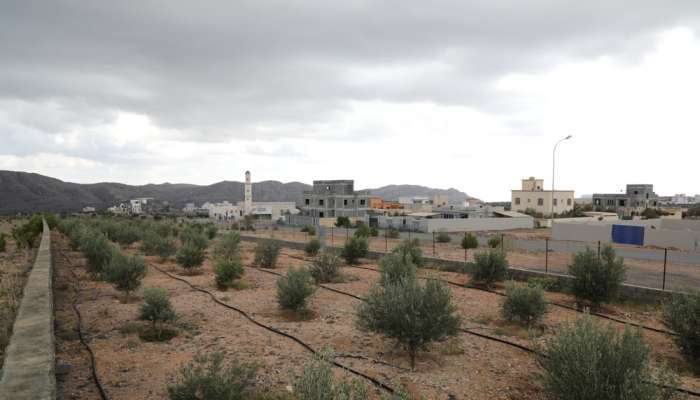
He stated that the governorate is witnessing the implementation of a number of qualitative projects aimed at raising the efficiency of agricultural production and enhancing its sustainability, most notably the tissue culture project in the Wilayat of Nizwa with an investment of nearly OMR4 million to produce date palm offshoots and improved seedlings, alongside projects for the production of saffron, olives, figs, and agricultural seedlings, contributing to diversifying agricultural production, raising its efficiency, and enhancing the sustainability of agricultural resources.
Eng. Omar Al Busaidi stressed that Al Dakhiliyah Governorate is paying increasing attention to food industries as the main link in maximising added value.
A number of projects aimed at converting agricultural products into food industries are being implemented, led by the Nizwa Food Industries Factory with an investment exceeding OMR3 million, in addition to projects for the production, drying, and processing of figs, the production and refining of olive oil, and food packaging and storage projects, bringing the total value of investments in these projects to over OMR8 million, which enhances the competitiveness of national products and raises the efficiency of food supply chains.
He explained that agricultural investment is notably concentrated in the wilayats that possess comparative advantages, foremost of which are the Wilayats of Al Hamra and Jabal Akhdar, where investment opportunities were awarded via the “Tatweer” platform for projects to produce pomegranates, olives, figs, saffron, and roses, alongside a processing industry project for onion crops in the Wilayat of Samail, thereby enhancing the utilization of the competitive advantages of each wilayat and raising the economic value of agricultural products.
In the livestock sector, he explained that the governorate is implementing strategic projects to develop veterinary services and animal production, most notably the Al Bashair Veterinary Hospital in the Wilayat of Adam with an investment of about OMR1.7 million, which is the first integrated specialised veterinary hospital in the Sultanate of Oman through a public-private partnership, alongside a project for rearing and producing broilers, supporting livestock productivity and enhancing food security.
He pointed out that the fisheries sector is also witnessing an expansion in investments through the signing of a partnership agreement with the private sector to develop, manage, and operate the fish market in the Wilayat of Izki, alongside offering four investment opportunities to manage and operate fish markets in the governorate, contributing to developing the infrastructure of the sector, improving the quality of services, and enhancing the efficiency of marketing and distribution.
He noted that the performance indicators recorded until the end of May 2026 reflect the governorate’s success in implementing its investment programs according to the targets, supported by the partnership with the private sector, the development of investment platforms, and the preparation of sites designated for productive projects, thereby enhancing its ability to attract more qualitative investments during the next phase.
He stated that what has been achieved represents a transition from investing in agricultural potentials to building an integrated production system based on expanding investment, maximising added value, developing food industries, and empowering the private sector, thereby enhancing Al Dakhiliyah Governorate’s position as a national pillar in the food security system, and supporting the objectives of Oman Vision 2040 in economic diversification and achieving sustainable development.
-ONA