Sunday 23 / August / 2026
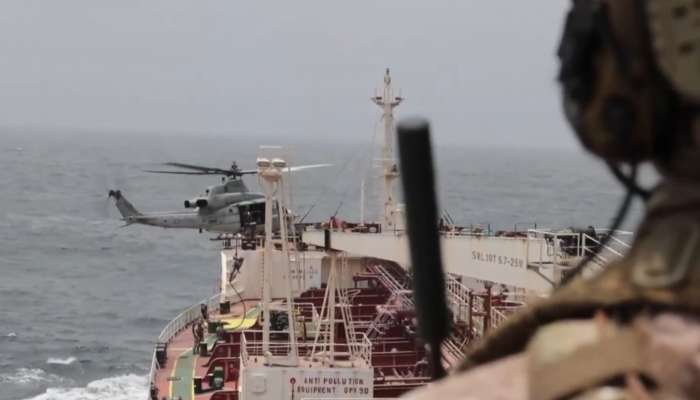
Washington, DC: US Central Command said on Saturday (that the American naval blockade against Iran remains in full effect, emphasising that two ships that didn't comply with orders were "disabled," while two others were boarded "to ensure total compliance."
In a post on X, CENTCOM disclosed that coalition forces have redirected 12 commercial vessels attempting to breach the perimeter as part of an ongoing effort to restrict unauthorised maritime transport bound for Iranian ports.
Detailing specific interdictions across key Middle Eastern maritime corridors, CENTCOM reported that US forces completed a verification inspection in the Arabian Sea.
"Earlier today, U.S. forces completed a verification boarding aboard Comoros-flagged M/T Charminar in the Arabian Sea, and the tanker is now continuing its journey," the statement read.
By contrast, US forces took direct action against another commercial vessel operating in the Gulf of Oman.
"CENTCOM forces disabled Mozambique-flagged M/T Lavine in the Gulf of Oman, July 24, after the crew attempted to violate the blockade multiple times and ignored repeated warnings," CENTCOM stated, noting that "the ship is no longer transiting to Iran."
The command underscored that maritime interdictions will continue indefinitely across key regional waterways.
"The U.S. naval blockade against Iran remains in full effect," CENTCOM emphasised, adding that American forces "remain highly vigilant, focused, lethal, and ready."
The latest interdictions highlight ongoing vigilance across key Middle Eastern maritime corridors, including the Gulf of Oman and the Arabian Sea.
Earlier in the day, the naval forces of Iran's Islamic Revolutionary Guard Corps (IRGC) targeted four commercial ships in the southern Strait of Hormuz over 24 hours, aiming to force the vessels to halt and alter course.
Iranian state broadcaster IRIB reported that the vessels were navigating an "illegal and unsafe route", though official channels did not disclose the names or nationalities of the intercepted ships. No reports of casualties or structural damage have emerged following the intercepts in the crucial oil transit corridor.
This follows a separate attack on a commercial vessel within Iranian territorial waters on Friday, involving the Mozambique-flagged LPG tanker DISHA, which carried 28 Indian crew members.
Confirming the incident, the Indian Embassy in Tehran stated that it was actively monitoring the situation alongside local authorities, reassuring that all personnel aboard remained unharmed.
Subsequently, dozens of vessels continued to navigate the narrow Bab el-Mandeb Strait despite persistent threats from Iran-backed Houthi rebels, according to a New York Times analysis of shipping data.
However, the report highlighted that growing uncertainty regarding the conflict and maritime safety is forcing several ships to alter course and execute U-turns before completing their journeys.
In the past week, Houthi rebels in de facto control of Yemen targeted at least three oil tankers, with the latest strike occurring on Friday.
Any sustained disruption in the Red Sea threatens to deal a fresh blow to global commerce, which is already reeling under the strain of the expanding Middle East conflict.
The war between the United States and Iran, now in its fifth month, has severely curtailed transit through the Strait of Hormuz, a crucial maritime corridor that previously carried approximately one-fifth of global oil supplies.