Tuesday 18 / August / 2026
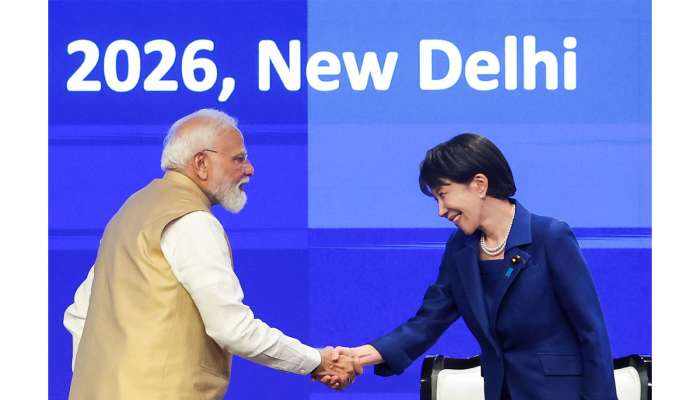
NEW DELHI: India and Japan are seeking to deepen their strategic partnership and sustain their shared Indo-Pacific vision amid shifting geopolitical dynamics and growing uncertainty over the future role of the Quad.
Japanese Prime Minister Sanae Takaichi's visit to New Delhi from July 1-3 for the 16th India-Japan Annual Summit placed economic cooperation, defence and security, technology, energy resilience and people-to-people exchanges at the centre of bilateral discussions.
The summit followed Prime Minister Narendra Modi's visit to Tokyo for the 15th India-Japan Annual Summit in August 2025 and produced a series of agreements and initiatives aimed at expanding the two countries' Special Strategic and Global Partnership.
Japan also announced plans to invest around ₹1 trillion in India across areas including infrastructure, connectivity, science and technology, artificial intelligence, innovation and business.
The two sides also discussed cooperation in defence and maritime security, including progress on the UNICORN defence project, JIMEX naval exercises and maritime domain awareness. Connectivity projects linking Northeast India with the wider Indo-Pacific region were another area of focus.
Beyond the bilateral agenda, however, the summit comes at a time when the strategic environment surrounding the Indo-Pacific and the Quad is undergoing significant change.
The United States' decision to restore the Pacific Command designation has raised questions about Washington's longer-term approach to the Indo-Pacific framework. The designation had been changed to Indo-Pacific Command in 2018, reflecting the growing strategic importance attached to the Indian Ocean alongside the Pacific.
The change has also renewed debate over the future of the Quad grouping comprising India, Japan, the United States and Australia, particularly as Washington seeks to manage its increasingly complex relationship with China.
India and Japan have a particular stake in the future of the Indo-Pacific concept. The two countries were among its principal strategic proponents, with former Japanese Prime Minister Shinzo Abe's 2007 "Confluence of the Two Seas" speech in the Indian Parliament providing an important intellectual foundation for the idea of linking the security and prosperity of the Indian and Pacific oceans.
The concept subsequently became a central feature of regional strategic cooperation, including through the establishment and expansion of the Quad.
At the latest India-Japan summit, the two countries reiterated the importance of the Quad and discussed regional challenges including maritime security in the South China and East China Seas, supply-chain resilience, energy security and connectivity.
The Quad remains relevant, but its evolution has been gradual. Its members continue to conduct leaders' and ministerial-level meetings, maritime exercises and cooperation on areas such as resilient supply chains, critical technologies, infrastructure, health and disaster response. At the same time, the grouping has yet to develop the kind of formal institutional structure or major strategic outcomes associated with a conventional alliance.
This leaves the Quad's future closely tied to the political will and strategic priorities of its four members.
For India and Japan, the challenge is therefore not simply whether the Quad survives, but how it adapts to changing regional circumstances. Even if the United States places greater emphasis on the Pacific or seeks tactical accommodation with China, strategic competition between Washington and Beijing is unlikely to disappear.
At the same time, China remains a central factor in the region's security environment, while maritime disputes, critical-mineral competition, supply-chain vulnerabilities, technological rivalry and non-traditional security threats continue to affect the interests of all four Quad members.
These overlapping interests provide a continuing basis for cooperation.
For New Delhi and Tokyo, sustaining the Indo-Pacific vision may consequently require a longer-term commitment independent of short-term shifts in US policy. The strategic concept has already evolved from earlier discussions of an "Asian Century" into the broader Indo-Pacific framework, and both countries may now have an interest in ensuring that the concept remains durable rather than being replaced by another strategic formulation.
The India-Japan partnership is therefore likely to remain important even as the wider regional architecture changes. Their cooperation in maritime security, defence, technology, energy, connectivity and economic security can provide a foundation for maintaining the Indo-Pacific framework and keeping the Quad relevant.
The Quad may not evolve into a formal alliance, but its continued existence is likely to depend on its ability to respond flexibly to common challenges.
As long as India, Japan, the United States and Australia continue to share significant strategic interests across the Indo-Pacific, the grouping is likely to evolve rather than disappear. The intensity of cooperation may fluctuate with geopolitical circumstances, but the underlying rationale for collaboration is expected to remain.