Tuesday 25 / August / 2026
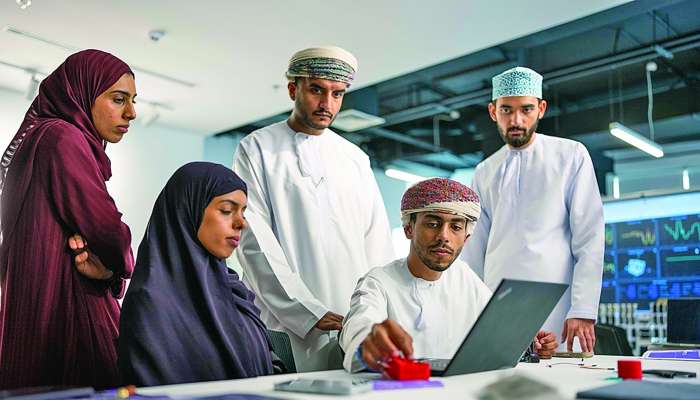
Muscat: The rapid changes and transformations taking place in the modern world are giving rise to new forms of employment shaped by the realities of everyday life.
As the concept of a job shifts from its traditional path toward a more flexible space for innovation and self-created opportunities, young people are becoming more aware of how to engage with and adapt to this reality. Moving beyond the traditional concept of employment while embracing global trends has encouraged young people to develop independent specializations rather than wait for ready-made professions.
One of the factors contributing to this shift is the emergence of indicators pointing to opportunities that create jobs for individuals and provide different and non-fixed sources of income based on specific models.
This is taking place amid the growing role of modern technology, digital innovations and their governance, which are helping societies make better use of the capabilities they have developed.
This raises several questions about the impact of the digital economy in encouraging young people to develop independent specialisations, work toward designing professions and explore innovation to create jobs that do not yet exist, and genuinely seek occupations that meet the demands of the future and are currently absent from the labour market. It also highlights the motivations behind creating such professions, including personal curiosity, particularly in technology, the arts and artificial intelligence.
In this context, Talal bin Khamis Al Bahri, Senior Technician at the Educational Technologies Center at Sultan Qaboos University, said that the concept of a “job” in its traditional form had become deeply rooted in the consciousness of Omani youth. This attachment began in childhood, with employment viewed as a noble means of serving the nation, aligning academic and practical qualifications, and ensuring well-being and stability.
However, he noted that rapid global changes, the digital revolution and the intersection of cultures — regardless of geographical distance — have made communication and innovation increasingly prominent and brought about a fundamental shift in this concept, while the strong sense of national belonging remains firmly rooted.
Al Bahri added that Omani youth are no longer merely seeking traditional employment. They are now capable of successfully managing their own projects, relying on limited human resources and artificial intelligence tools that help them complete their tasks efficiently. He said young people are finding genuine enjoyment in this transformation, which meets the changing demands of the market and diversifies areas of creativity and production.
He pointed out that under the traditional model, an employee follows a single career path throughout their working life, largely characterised by routine, with advancement generally limited to gradual promotion to higher positions when opportunities arise. The innovative career path, by contrast, relies on horizontal skills and the ability to move between departments and specialisations, broadening employees’ horizons and developing their integrated experience.
He explained that traditional thinking continues to place emphasis on lifelong job security because it provides psychological comfort and stability extending until retirement. However, security in a flexible career path is no longer tied to a particular position, but rather to acquired skills. Those who keep pace with modern technological developments and invest in artificial intelligence can strengthen their career stability and achieve sustainable success.
Regarding the traditional workplace structure, Al Bahri said leadership was once concentrated at the top of the hierarchy, with employees merely carrying out orders and remaining distant from decision-making. In a flexible environment, however, employees have become partners in decision-making and even decision-makers within their areas of work, transforming them from mere executors into successful innovators.
He also explained that the traditional “trial-and-error” culture had a negative impact, as employees came to believe that failure warranted punishment, creating a fear of taking risks. The flexible career model, by contrast, embraces learning from mistakes and encourages innovative solutions at the lowest possible cost, viewing failure as a step toward success.
On the financial front, he said major companies around the world are increasingly moving toward sharing profits with innovative employees in recognition of their contributions. This contrasts with the traditional system, which is limited to a monthly salary and an annual bonus, where applicable, creating a clear financial gap between the two models.
Al Bahri summarised the difference by saying that the modern career path provides an open working environment that promotes the flow of ideas and collaboration among teams, unlike the closed atmosphere of the traditional career path, which limits creativity and communication and isolates work from the spirit of innovation.
Regarding the digital economy and global trends encouraging young people to develop independent specialisations rather than wait for ready-made professions, Al Bahri said Omani youth are not isolated from the digital world.
Rather, they are adapting to the technological wave and the major digital transformation taking place globally. The international economic shift is encouraging young people to embrace self-reliance instead of traditional employment. The artificial intelligence and automation revolution has opened the door to new professions through which Omani youth can generate substantial income while managing projects from their mobile phones with the help of AI tools and in line with global trends.
He added that this has contributed to a shift in economic resources from those based on oil abundance, as he put it, toward resources based on human beings and their intellectual and mental capabilities.
He also noted that the COVID-19 pandemic demonstrated how digital businesses could provide greater resilience amid market fluctuations, while those relying on traditional employment witnessed layoffs.
He stressed that artificial intelligence and automation are increasingly penetrating different fields through big-data analysis, allowing young people to specialize in these areas and provide services across a wide range of disciplines.
Meanwhile, Rahma bint Said Al Rashidi, a graphic designer specializing in strategic communication and generative AI applications, said the future of work is no longer based on the random emergence of new jobs, nor are future professions necessarily built around separate specialisations. Instead, they are emerging from the reshaping of professional roles at the intersection of human knowledge and modern technologies.
With the rapid development of generative artificial intelligence, she said, new professional roles have begun to emerge that were unknown only a few years ago, driven by institutions’ need for skills combining creative understanding with technical capabilities.
She pointed to prompt engineering as a clear example. It has become a new professional skill with the spread of AI models.
Crafting prompts for intelligent models has become a specialised process requiring an understanding of how these models work and the ability to transform ideas and objectives into precise instructions that produce higher-quality and more effective outputs.
As the field develops, she noted, roles combining technology with creative disciplines are emerging, including AI-based visual content design, the development of specialised prompt libraries and the management of the quality of outputs generated by intelligent models.
In the field of design, Al Rashidi said artificial intelligence has become a partner in the creative process. Designers are using AI image-generation tools to develop visual concepts, create prototypes and build creative experiences more quickly and flexibly, while retaining their creative role in directing ideas and transforming them into valuable visual outputs.
She stressed that this transformation is creating opportunities for specialists who combine design skills with an understanding of AI technologies — skills that are becoming increasingly important in the labor market as digital transformation accelerates.
Institutional communication is undergoing a similar transformation. She said the role of specialists is no longer limited to drafting messages and managing content, but now extends to using artificial intelligence to analyse audiences, develop ideas, produce written and visual content, and build smarter and more effective communication strategies.
This is creating a need for professional roles that combine strategic communication with intelligent technologies.
She further emphasised that, in her view, personal curiosity is the primary driver behind the creation of these professions. Future jobs often do not emerge from a single specialization, but from the intersection of different fields.
A person who combines design with artificial intelligence, or institutional communication with intelligent tools, can develop a new professional model that brings together multiple disciplines. Such combinations can evolve into innovative roles and services that respond to future needs.
She explained that the ability to engage in continuous learning, explore emerging technologies and integrate them into different specialisations is one of the most important factors enabling individuals to contribute to the creation of new professions that correspond with rapid changes in the labor market.
Al Rashidi described this transformation as an opportunity for Omani youth to redefine their relationship with the labor market by developing hybrid skills that combine creativity and technology, and by taking the initiative to create services and professional roles that respond to the needs of institutions in the digital age.
She said the future will belong to those capable of anticipating needs, identifying opportunities and designing new professional roles that meet the requirements of the coming stage.
For his part, Saeed bin Mubarak Al Ghanami, Vice Chairman of the Board of Directors of the Oman Information Technology Society, said that Oman’s labour market a decade from now, amid rapid and continuous technological change, will differ less in the names of professions than in how they are practiced and how their capabilities are utilised.
Doctors, engineers, teachers, accountants and other core professions will remain essential in the labour market, he said, but the difference will lie in the tools they use, the skills that distinguish them and the impact they deliver. The speed of work and quality of outputs will also change significantly and gradually, rather than overnight.
Although new jobs are expected to emerge as a result of these changes, he said he does not believe the next generation will rely entirely on professions that do not exist today. Instead, they will work in an environment where disciplines overlap and jobs become more flexible, relying on digital knowledge, data and artificial intelligence.
He added that in Oman, this change coincides with the objectives of Oman Vision 2040, through expansion in digital economy, artificial intelligence, renewable energy, logistics, tourism and sustainability. These sectors will not only create new employment opportunities, but will also reshape existing professional roles and generate roles that combine more than one specialisation to achieve greater integration in meeting institutional objectives and performance indicators.
He said Oman could see specialists in precision agriculture using artificial intelligence, experts in predictive maintenance for power plants, designers of smart tourism experiences and professionals responsible for AI governance within institutions.
These examples reflect the labor market’s transition from separate specializations toward hybrid professions that combine sector-specific knowledge with advanced technologies.
He also stressed the importance of distinguishing between simply using artificial intelligence technologies and deploying them to create genuine economic value. Using these technologies to write texts, prepare presentations or perform routine tasks increases productivity, but in itself does not constitute a sustainable competitive advantage, as these technologies are now widely available and will become increasingly easy to use. Real value begins when such technologies are used to solve real-world problems, develop a new service or redesign how a service is delivered.
He illustrated this by contrasting someone who uses AI to prepare a marketing plan with another person who develops a platform that helps public or private institutions analyze customer behaviour, predict their needs and improve marketing decisions.
The difference, he said, lies between someone who uses technology in a conventional manner and someone who creates a valuable service capable of growing into a business and generating new employment opportunities.
He concluded that future competition will not be between those who possess artificial intelligence tools, but between those who can use them to understand market needs, solve problems and develop services and products with economic impact.
Technology is available to everyone, but the ability to transform it into added value will create the most sustainable and competitive jobs and give Omani youth the opportunity not only to keep pace with the future, but also to help shape it.