Saturday 19 / September / 2026
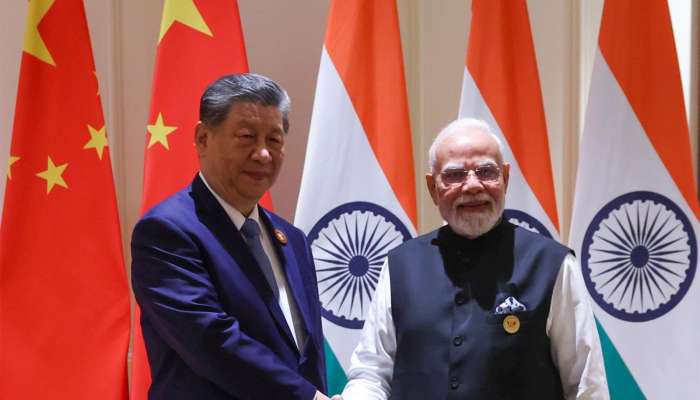
New Delhi: The meeting between Chinese President Xi Jinping and Indian Prime Minister Narendra Modi on the sidelines of the 18th BRICS Summit in New Delhi on Saturday has underscored the strategic importance of China-India relations and pointed to a pragmatic path for further cooperation.
The meeting comes as the two Asian powers seek to consolidate hard-won stability in bilateral ties while managing longstanding differences. Both sides stressed the importance of drawing on their respective strengths to pursue common development and support each other’s growth.
Recent meetings between Xi and Modi have contributed to stabilising relations and preventing differences from overwhelming the broader bilateral relationship. The economic stakes are considerable. According to China’s General Administration of Customs, bilateral trade in goods rose 12.4 percent year-on-year to a record $155.6 billion in 2025. China also re-emerged as India’s largest trading partner in the 2025-26 fiscal year.
The two economies are closely interconnected, with Chinese industrial supplies playing an important role in India’s manufacturing sector, while India provides a vast market for Chinese products.
Given the scale of their economic relationship and the combined population of more than 2.8 billion, the trajectory of China-India ties carries implications well beyond bilateral relations. It can influence Asian supply chains, regional stability and the wider geopolitical balance, particularly at a time of rising unilateralism and bloc-based confrontation.
As two of the world’s most populous countries and major members of the Global South, China and India also have a broader responsibility to promote an open and stable international economic environment.
Xi called on the two countries to work together to advance high-quality development of “greater BRICS” cooperation, pursue win-win outcomes, expand people-to-people exchanges and use political wisdom to overcome disruptions.
He also urged the two sides to pursue parallel progress in bilateral relations and the handling of border issues, with the two tracks reinforcing rather than undermining each other. At the multilateral level, he called for greater cooperation based on openness and inclusiveness.
The approach offers a pragmatic framework for the two neighbours: deepen areas of common interest, manage differences through dialogue and gradually build mutual trust.
Modi’s assertion that China-India relations should not be influenced by external geopolitical agendas, and that India is prepared to be a partner rather than a rival to China, could further contribute to creating a favourable atmosphere for bilateral engagement.
For both countries, the priority now is to translate the political direction established by the leaders into practical cooperation. Existing differences will need to be handled carefully through dialogue and negotiation, while new areas of economic, technological and people-to-people cooperation should be explored.
Economic and trade relations will remain particularly important. As Xi noted, the two sides should take account of each other’s concerns and work towards the sound and stable development of bilateral economic and trade ties.
Stronger coordination within BRICS and other multilateral platforms could reinforce these efforts. By combining bilateral engagement with broader cooperation among emerging economies, China and India can contribute to stronger regional supply chains, greater economic opportunities and a more influential voice for the Global South.
The Xi-Modi meeting therefore points towards a relationship based not on the absence of differences, but on the ability to manage them while building areas of common interest. For two countries of such scale and importance, sustained dialogue and practical cooperation remain essential to ensuring that competition does not overshadow the wider possibilities of partnership.