Sunday 18 / October / 2026
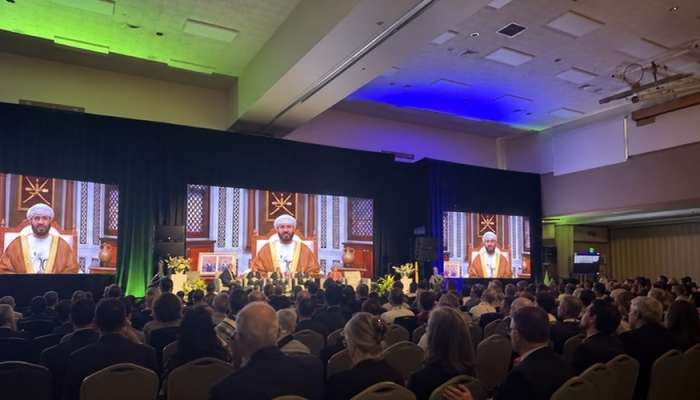
Utah — The Sultanate of Oman, represented by the Ministry of Endowments and Religious Affairs, participated in the G20 Interfaith Forum held in Salt Lake City, United States (US), under the theme "Resilient Hope, Shared Future."
Dr. Mohammed Said Al Maamari, Minister of Endowments and Religious Affairs, delivered a speech during the plenary session titled "Energy Policies, Religion, Peace, and Human Prosperity." In his address, the Minister discussed the relationship between energy resources and the values of equity, sustainability, and peace, emphasizing the importance of transforming resources into shared prosperity that preserves human dignity and the rights of future generations.
He noted that balancing energy supply security, affordability, and environmental preservation is not limited to technical and economic aspects alone, but is also linked to moral values established by religions based on utilizing resources without harming others or the environment, or depriving future generations of their rights.
Al Maamari reviewed the civilizational experience of the Sultanate of Oman and its centuries-long interaction with the peoples of the world through maritime navigation, referencing Omani-American relations established by the Treaty of 1833, as well as the arrival of the Omani ship "Sultana" in New York in 1840, carrying the first Arab envoy to the United States.
He touched upon the aflaj system—five of which are inscribed on the UNESCO World Heritage List—and what it embodies in terms of responsibility in managing resources and preserving the rights of others, as well as the endowment (waqf) system, whose impact extends across generations.
He emphasized that the Omani model of coexistence is based on dialogue, good neighborliness, and mutual respect, citing the contributions of the "Message of Peace" and "Human Coexistence" projects in raising awareness about shared human values. He also highlighted the launch of the "Muscat Plan" in June of this year from the United Nations headquarters in New York, in partnership with the United Nations, the United Nations Alliance of Civilizations (UNAOC), and the Network for Religious and Traditional Peacemakers.
The Minister explained that the plan was the outcome of a consultative process involving religious and traditional leaders as well as representatives of indigenous peoples to enhance the role of these leaders in conflict prevention and combating hate speech, based on the principle that peace among nations begins with trust within communities.
He clarified that achieving energy security and sustainable development requires instilling fairness in resource distribution, ensuring the sustainability of their benefits, and strengthening trust and fulfillment of commitments. He stressed that priority should be given to communities that have not yet been reached by energy services, and that abundance and sustainability can complement each other under moderation and the reduction of waste and environmental harm.
Al Maamari pointed out that the concept of stewardship places humanity in a position of responsibility for the Earth and its resources, requiring that decisions take into account affected communities and the generations that will inherit their outcomes. He confirmed that prosperity, from a religious perspective, is measured by human dignity and that peace represents a paramount goal, with religious and traditional leaders playing a role in building trust and enhancing understanding among communities.
The Minister of Endowments and Religious Affairs called on G20 leaders to formulate energy and development policies that safeguard supply security, expand opportunities, and preserve the rights of future generations, while recognizing religious and community institutions as essential partners in shaping and executing transformation pathways.
At the conclusion of his speech, he reaffirmed that energy security in an interconnected world cannot be achieved for anyone unless it is achieved for all, and that sharing resources necessitates sharing responsibility for them, turning them into a force for cooperation and a path toward shared prosperity and peace.
The forum discussed several international issues, most notably the role of religious institutions in promoting peace and sustainable development, interfaith dialogue, the ethics of artificial intelligence, and contemporary humanitarian challenges, with the participation of religious leaders, officials, and experts from around the world within the framework of enhancing international cooperation and solidifying values of human understanding and coexistence.