Monday 09 / November / 2026
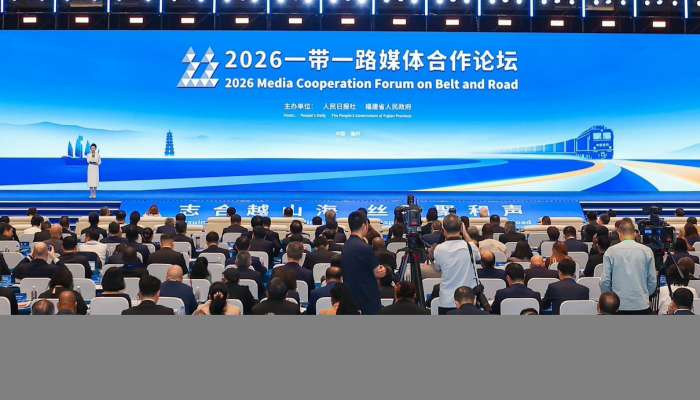
Fuzhou: The "Belt and Road" Media Forum 2026 was recently held in Fuzhou, Fujian Province, in southern China. The event brought together over 200 participants from 100 countries, as well as various international and regional organizations, representing 182 media institutions and outlets. Muscat Media Group participated on behalf of the Sultanate of Oman. The forum was held under the theme "Towards Common Understandings and Shared Aspirations Along the Belt and Road," with support from international marketing development initiatives.
The participants emphasized that the joint development of the "Belt and Road" Initiative has evolved from a Chinese initiative into an international practice, becoming a "public good" for the peoples and nations of the world, as well as the largest and most influential platform for international economic cooperation globally.
This comprehensive event was organized by the *People’s Daily* in collaboration with the People’s Government of Fujian Province. The forum drew a diverse group of political, media, and academic leaders from across the globe, who—through their speeches and contributions—underscored the pivotal role of the media in fostering cross-civilizational dialogue and strengthening the foundations of international economic cooperation. This is particularly relevant within the context of the Chinese-initiated, globally beneficial framework launched by President Xi Jinping in 2013, under the guiding principle of "mutual benefit for all." Since its inception, this initiative has spurred hundreds of mega-projects along the historic "Maritime Silk Road," connecting China to the rest of the world through bilateral and multilateral economic, trade, and investment partnerships.
The forum also featured three parallel sessions: the 2026 Regional Cooperation Forum for the "Belt and Road" Initiative, the 12th Seminar on Media Cooperation among ASEAN Plus Three countries (China, Japan, and South Korea), and the 2026 Silk Road Civilization Development Forum. Additionally, the fourth meeting of the Belt and Road News Network (BRNN) Council—focused on news and media cooperation—was held. Following the opening ceremony, an accompanying exhibition showcasing the outcomes of cooperation under the Belt and Road Initiative was inaugurated, highlighting the achievements attained through the joint development of the initiative.
Participants at the forum’s opening session, held in the presence of senior representatives of the Chinese government, the Communist Party of China, and People’s Daily, including Mr. Yu Shaoliang, President of People’s Daily, emphasized the importance and necessity of strengthening cooperation among media organizations in different countries to better tell the stories of the Belt and Road Initiative. Such cooperation, they noted, would contribute to enhancing policy communication and fostering closer ties among peoples.
The keynote speeches focused on three strategic pillars shaping the future of media and economic cooperation. The first was strengthening “Partnership” through the exchange of content and technical expertise to sustain the project’s positive momentum. The second was promoting the concept of “Connectivity” as a bridge bringing cultures and markets closer together, while emphasizing the importance of local expression and a global perspective in overcoming perceptual barriers and narrowing the psychological distances between peoples.
In her opening remarks at the forum, Xian Hui, Vice Chairperson of the National Committee of the Chinese People's Political Consultative Conference, highlighted the strategic importance of Fujian Province as the historical starting point of the Maritime Silk Road.
She also underscored the significance of strengthening cooperation among media outlets from various countries, noting their role in facilitating the exchange of development experiences and fostering mutual understanding and closer ties between peoples. She pointed out that the forum—which has evolved alongside the "Belt and Road" Initiative—has become a vital platform for dialogue, exchange, and practical cooperation among media organizations.
Hui emphasized the importance of the media in aligning development strategies among the initiative’s participating countries, highlighting connectivity projects, and showcasing initiatives that improve people’s lives. She expressed her hope that the forum would contribute to strengthening friendships, deepening media partnerships, and sharing stories of cooperation along the Silk Road.
Yu Shaoliang, President of the *People’s Daily*, emphasized during the opening session of the "Belt and Road" Media Cooperation Forum the importance of strengthening partnerships among media outlets from countries participating in the initiative. He noted that the forum has become a vital platform for dialogue and practical cooperation, fostering mutual understanding, trust, and closer ties between peoples.
Yu explained that the *People’s Daily* is working with media organizations in participating countries to develop sustainable, multi-faceted cooperation. He underscored the significance of leveraging existing cooperation mechanisms to expand the exchange of journalistic material, co-produce content, and collaborate on technical research, development, and professional training—all of which contribute to delivering high-quality content that supports the joint development of the "Belt and Road" Initiative.
The forum’s proceedings focused on the significance of the Belt and Road Initiative as a broad platform for international economic cooperation and a public good that contributes to the shared development of nations and peoples worldwide. It was noted that the Belt and Road Media Cooperation Forum has evolved into a global platform for mutual understanding and collaboration in support of the initiative’s objectives.
Furthermore, the forum highlighted the vital role of the media; participants emphasized the necessity of conveying an accurate picture of the initiative, showcasing its developmental outcomes, and fostering greater connectivity among peoples.
Participants emphasized the necessity of combating disinformation, explicitly calling for enhanced coordination among international media organizations to counter misleading information—particularly within Western media—and to disseminate reliable facts that inform the public about the opportunities and benefits of the initiative, especially for countries in the Global South.
On the sidelines of the forum, the "Fuzhou Initiative" for media cooperation among "Belt and Road" countries was officially launched. This initiative aims to establish a permanent institutional mechanism to coordinate media efforts, facilitate the exchange of news and information, and support joint projects that foster a positive public perception of the initiative globally, thereby ensuring sustained cooperation among the participating media organizations.
The speakers concluded the first day by emphasizing the need to unite "forces" to address global media challenges through a rational and objective stance, conveying the aspirations of societies for shared prosperity and a more stable, integrated future for the benefit of all humanity.
The second day of the forum featured the fourth meeting of the Council of the "Belt and Road" News and Media Cooperation Network, held in Fuzhou, Fujian Province. The meeting brought together representatives from 38 media organizations across 23 countries. In its capacity as the Council’s chair, the *People’s Daily* presented a report on the activities of the third term, highlighting the Council’s success—since its renewal in August 2024—in fostering media cooperation and innovation, as well as broadening consensus regarding the "Belt and Road" Initiative. The number of member organizations in the network has grown to 327, representing 120 countries—an increase of 19% compared to 2024—further solidifying its position as a platform for international media cooperation.
The participants agreed to continue developing the Forum’s initiatives and adopted the "Joint Declaration of the Fourth Meeting," which called for promoting development, peace, stability, and cultural exchange, as well as leveraging smart technologies and intensifying media cooperation.
Furthermore, the formation of the Council’s fourth term was announced, with the inclusion of 42 media organizations from 26 countries. Representatives of the member organizations also discussed ways to strengthen the network’s role, further develop the "Silk Road Award" for international media, and foster closer ties between peoples.
The participants reaffirmed their commitment to the spirit of the Silk Road, pledging to continue playing their part in promoting the "Belt and Road" Initiative and fostering mutual understanding and friendly exchanges among peoples—thereby contributing to the building of a community with a shared future for mankind and supporting global peace, prosperity, and development.